menuclose
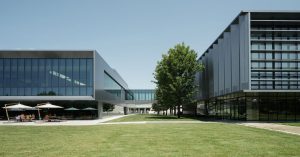
MF01 Office Building at the Batlleiroig Campus in Esplugues de Llobregat

Les noves oficines (MF01), al mateix carrer que les actuals, formen part d’un nou projecte transversal i d’usos mixtos (oficines, habitatge i urbanització), esdevenint el tercer edifici del campus Batlleiroig a Esplugues de Llobregat, després de la seu original i la casa Moratiel, projecte de l’arquitecte Josep Maria Sostres.

Oficines MF01 a Esplugues de Llobregat

Offices in Esplugues de Llobregat

Dos nivells topogràfics molt marcats, amb habitatges a la cota superior i el sòcol com a oficines, conformen un projecte que permet la continuïtat del carrer, resolent el cul de sac de Manuel Florentín i connectant-lo amb el carrer contigu, integrant la ciutat. Una intervenció alineada amb els valors de Batlleiroig, dissenyada segons els màxims estàndards de sostenibilitat i concebuda des d’una perspectiva transversal, amb espais de treball de qualitat en contacte amb la vegetació, que amplia el campus Batlleiroig a Esplugues de Llobregat.

Authors

Batlleiroig Arquitectura. Enric Batlle Durany, Joan Roig i Duran, Albert Gil Margalef, Helena Salvadó Giné – Architect

Team

Josep Batlle Blay, Alejandro Álvarez Gómez, Ramón Illan Salas, Anna Porta Almagro, Joan Batlle Blay, Mercè Lorente i Gras, Isabel Pérez Manén – Architect / Victor Susagna Holgado – Building engineer

Collaborators

BBG – Estructures

Promoter

BIR AUGUSTA, SL

Construction company

Forcimsa

Project status

In drafting

Year

2025

Connecting and reclaiming history

El creixement constant de Batlleiroig va portar, l’any 2019, a l’ampliació dels espais de treball amb la incorporació d’un nou edifici al carrer Manuel Florentín, a pocs metres de les oficines MF15. Aquesta intervenció es situa a prop de l’antiga Via Augusta, un recorregut històric que passava per Esplugues de Llobregat però va quedar esborrat amb l’aparició de noves infraestructures. Actualment, es treballa en la recuperació simbòlica d’aquest trajecte històric mitjançant escultures de Xavier Corberó que serveixen de fites i evoquen la seva memòria.

La parcel·la definitiva va sorgir d’una modificació puntual del Pla General Metropolità que va permetre la continuïtat del carrer fins a unir-se amb Apel·les Mestres, obrint així el cul-de-sac de Manuel Florentín. Aquesta modificació també va permetre l’augment de la densitat residencial de 4 a 6 habitatges amb accés des d’Apel·les Mestres, així com la incorporació de les nostres oficines amb accés des de Manuel Florentín.

El projecte d’urbanització connecta els carrers Manuel Florentín i Apel·les Mestres, adaptant la topografia amb un pendent suau que permet l’accés a la parcel·la des de tots dos costats. Abans de la intervenció, aquesta zona era un espai tancat i en desús, sense connexió entre els carrers. Amb la nova actuació, es crea una integració fluïda entre les vies, millorant l’accessibilitat i obrint un nou espai públic que enllaça la trama urbana, enriquint així l’entorn.

Connection between Manuel Florentín and Apel·les Mestres through the new intervention. Map of the lost route of the Via Augusta as it passed through Esplugues de Llobregat and its recovery in the collective memory through the artistic intervention of Xavier Corberó. © Batlleiroig

Coherent integration into the terrain

Igual que a les oficines MF15, el projecte s’aprofita de la topografia accidentada del lloc per col·locar els dos usos principals un sobre l’altre. A la part alta, a peu pla i entrant per Apel·les Mestres, es situa l’accés als habitatges, que, en aquesta mateixa cota, disposen de sortida directa als seus jardins privats. Per sobre d’aquest nivell, les vivendes compten amb dues plantes addicionals dedicades als usos més privats.

A la part inferior, les futures oficines de Batlleiroig tenen un accés principal a peu pla des de la carrer Manuel Florentín i un accés de servei des de la zona inferior de carrer Apel·les Mestres.

El nou edifici incorpora dos usos diferents en un únic volum arquitectònic. El correcte funcionament dels dos programes es fa possible gràcies a una secció esglaonada que aprofita la topografia del terreny, permetent accessos diferenciats i oferint així independència total entre els espais.

Aquesta solució arquitectònica optimitza la ventilació creuada i l’entrada de llum natural a totes les zones de l’edifici, millorant el confort ambiental i l’eficiència energètica. L’ús intel·ligent de la secció esglaonada no només respon a les necessitats funcionals, sinó que també contribueix a la integració harmònica de l’edifici amb el seu entorn, adaptant-se a les particularitats de la parcel·la i establint una connexió fluïda amb els espais exteriors.

The building's section adapts to the terrain while providing an ideal solution to integrate the two programs into a single volume and provide them with the best climatic conditions. © Batlleiroig

Spaces that promote teamwork

Access to the offices is through outdoor spaces that include bicycle parking, thus promoting sustainable mobility among the workers. In addition, these outdoor spaces offer areas for contact with nature, contributing to the well-being of the users.

The offices, with a total area of 1,540 m² plus 400 m² of parking, are distributed over two main floors, where the open-plan workspaces, rest areas, and meeting rooms are located. The workspaces, with a capacity for 120 people, include 7 meeting rooms of various sizes and capacities, 7 videoconference rooms or rooms for tasks requiring high concentration, 2 printing rooms, 2 office spaces on two floors, 130 m² of social spaces in direct contact with the outdoor areas, locker rooms equipped with showers, and spaces for lockers and cabinets to facilitate bicycle commuting.

On the first floor, users are welcomed into a reception area that leads to collaborative workspaces and an open office towards the outdoor areas. This floor is connected to the lower floor through an impressive open staircase, facilitating visual interaction and communication between the different levels.

On the lower floor, there is a spacious open-plan workspace illuminated with natural light coming from an interior courtyard, creating a pleasant and well-lit environment. In addition to these two main floors, the offices have two additional levels of 50 m² each, housing meeting rooms with stunning panoramic views of the sea and the Collserola Natural Park.

These spaces are expanded with more than 580 m² of outdoor areas, where workers can work, eat, or rest, promoting a more open and flexible work environment. The office design reflects Batlleiroig’s working philosophy, favoring open and bright spaces that encourage collaboration and teamwork in a harmonious setting integrated with the natural landscape.

Open-plan workspaces with high ceilings and natural light. © Batlleiroig

An efficient structural solution

The project adopts an innovative structural solution that efficiently combines three materials: wood, steel, and concrete. The mixed structure is predominantly wood, with metal columns and CLT panels, providing lightness and sustainability through the use of locally sourced wood. In the lower floors, a steel structure with a metal truss has been incorporated, allowing for large, open, and flexible spaces.

For the parking area, concrete has been used for containment and flooring, while for the residential areas, the entire structural system is made of CLT, including walls and floors. The offices use a mixed structure, with steel columns and beams and CLT flooring.

At the base of the building, in contact with the ground, a concrete base has been used to protect the wooden structure from moisture and provide thermal inertia to the interior spaces. For the retaining walls in the exterior areas, gabion walls have been used, constructed with natural, low-impact materials, thus minimizing the environmental impact.

This combination of structural solutions enables a 40% reduction in environmental impact compared to a conventional concrete structure, demonstrating the project’s commitment to sustainability.

An intervention aligned with Batlleiroig's values

The new Batlleiroig offices are a clear example of the company’s commitment to bioclimatic design, as they incorporate several passive measures that significantly reduce the building’s energy demand, maintaining it at 125,474 kWh annually. This approach helps minimize the need for air conditioning and heating systems, naturally improving the building’s energy efficiency.

In addition, the project promotes energy self-sufficiency through the implementation of advanced systems such as geothermal and aerothermal energy, which generate up to 97,000 kWh annually, covering a significant portion of the building’s energy needs and reducing dependence on the electrical grid.

Another notable innovation is the heat recovery system, which takes advantage of the mixed-use (residential and office) combination to exchange energy. The excess heat generated from the office cooling process can be used to produce hot water for the residential units, and vice versa.

To complement this renewable energy, photovoltaic panels have been integrated to generate additional energy for the offices, thus contributing to reducing energy dependence.

The project also incorporates responsible water management, with the implementation of a sustainable urban drainage system (SUDS) that uses permeable surfaces and swales to allow water infiltration into the soil, helping to recharge aquifers. Additionally, greywater recycling is planned for irrigation of green areas and for toilet use, and the management of stormwater is carried out through green roofs that gradually absorb water, reducing flood risks and promoting a balanced microclimate.

This set of measures highlights Batlleiroig’s commitment to sustainability, reducing the building’s carbon footprint and improving the well-being of the users. The project not only aligns with the company’s values but also reflects a strong commitment to responsible and energy-efficient architecture, creating spaces that address current environmental challenges and contribute to a more sustainable future.